Eurovision Song Contest 2026
Police information and media contact
Emergency? Do not use this page! Call 112 (European emergency number) or 133 (Austrian police). For media enquiries, use the contact below. Real-time police updates are published first on social media.
General information for this page
The Federal Police, together with ORF and the City of Vienna, is a central architect of the security framework for the Eurovision Song Contest 2026 (ESC). Frequently asked questions (FAQ) about security aspects and police preparations for the ESC can be found on this page. For any further questions, please contact the Federal Police communications team at the address listed below.
Press and communications
Write to us here wien-presse@polizei.gv.at
- Requests are handled in the order they are received.
- Please submit interview requests well in advance.
- Real-time incident information is published first via social media — not by email.
- For event-specific questions (tickets, transport, side events) visit https://songcontest.orf.at/faq
Follow us here
All police-relevant information (such as traffic updates) as well as dedicated ESC content will be published on our real-time social media channels. Crisis updates are published in real-time on Instagram, X/Twitter and Bluesky, as well as on our Homepage .
Security concept & responsibilities
Frequently Asked Questions on ESC Security
For event-specific questions (e.g. tickets, entry procedures, public transport, side events, etc.), please visit the ORF FAQ page: https://songcontest.orf.at/faq
What does the ESC security concept look like?
Responsibility for the overall security concept lies with the event organizer — in this case, the Austrian public broadcaster ORF. This concept has been developed with input from all relevant security partners, including not only the police but also emergency medical services, the fire brigade, and numerous other agencies.
For detailed questions about the ESC security concept, please contact the ORF here: http://presse.orf.at
Wo is responsible for security at the ESC?
Security responsibilities are divided between a private security service (inside the venue) and the police:
The ESC takes place primarily at the Wiener Stadthalle . As part of its security concept, the organizer (ORF) is responsible for venue security, which is handled by a contracted private security firm covering the interior of the venue (Wiener Stadthalle).
The police (as the public security authority) are responsible for public order and safety. For non-public spaces — such as private venues where events like the ESC are held — a private security provider must therefore also be engaged. The exception to this is criminal offences and emergency intervention, which always fall under the jurisdiction of the police.
Background: Unlike many neighbouring countries, Austria's police force is organized as a federal authority with nationwide jurisdiction — hence the name "Bundespolizei" (Federal Police). In addition to its central headquarters in Vienna (within the Ministry of the Interior), it operates through nine regional directorates, one per federal state. Since the Eurovision Song Contest is taking place in Vienna, the “Landespolizeidirektion Wien” (Vienna Police Directorate, LPD Wien) holds local authority.
Police preparations & units
What preparations is the police making for the ESC?
The police operation for the Song Contest 2026 spans the entire city like an invisible safety net. Extensive preparations — both in coordination with our security partners and independently — have been underway for many months and will reach their peak during the contest week.
Local operational authority rests with the Vienna Police, while numerous departments within the Ministry of the Interior (BMI) are working together to monitor the security situation and plan accordingly. The units deployed include in particular:
- Regular uniformed service — for public order policing and managing demonstrations/public assemblies
- Criminal investigation service, at both the state and the federal level
- State protection and counter-extremism, through the Landesamt Staatsschutz und Extremismusbekämpfung (Vienna Police) and the Directorate of State Protection and Intelligence (DSN) within the Ministry of the Interior
- Special units of the Ministry of the Interior (Directorate of Special Units), most notably the Cobra counter-terrorism unit and drone defence, the Air Police including drone pilots, and the bomb disposal service
- Special units of the Vienna State Police Directorate, in particular the WEGA rapid response unit, the police dog unit (including explosive detection dogs), the standby unit for public order duties, and specialist officers for explosives and hazardous materials
- The Vienna Police Traffic Division, handling traffic management and control
- Comprehensive cybersecurity structures linking the federal government, the City of Vienna, the Ministry of the Interior, and the event organiser
Several hundred additional officers will be deployed each day, with further support from colleagues in surrounding federal states. The Vienna Police operations center will be staffed 24/7 throughout the ESC to enable a swift and decisive response to any situation. Officers from both regular and specialist units will operate in uniform and in plain clothes — many units and capabilities will be active in the background or on standby, without a visible public presence.
What particular challenges has the police identified for the ESC?
The Eurovision Song Contest is inherently a complex event to organize, and that complexity makes it a security challenge as well — one that demands careful planning and professional risk management. The current geopolitical tensions and resentments they generate add an extra layer of pressure across Europe, particularly at large-scale events.
In operational terms, the key challenges include:
- Traffic management across the city
- Crowd control at the venue and public viewing events
- Managing expected protest activity
- Protecting guests and delegations
- Continuously monitoring the security situation/risk assessment in real-time
- Close coordination with all partner agencies for comprehensive risk management
The Vienna Police and the Austrian Ministry of the Interior have extensive experience in hosting major events and ensuring the safety of residents and visitors — in no small part due to Vienna's role as host city to many international organizations.
Protests & Demonstrations
Will there be protests and demonstrations — and how will the police respond?
Austrian assembly law gives everyone the right to express their views freely through public gatherings with minimal bureaucratic hurdles. There are very few restrictions on the form, location, or content of an assembly. A notification to the local authority 48 hours in advance is sufficient. Under Austrian law, no "permit" is required to hold a demonstration.
In Vienna, the LPD Wien (Vienna Police Directorate) serves simultaneously as security authority and assembly authority, and has extensive experience in the administration of public assemblies. Of the up to 15,000 assemblies held in Vienna per year, only a small number require a police escort or protection.
The ESC 2026 has already been accompanied by smaller demonstrations in recent weeks, all held peacefully and in accordance with the law. Registrations for demonstrations/assemblies have been received for the contest week, including the final day. This was anticipated from the outset of police planning and is subject to ongoing risk assessment.
The fundamental role of the authorities is to facilitate assemblies and protect the right to demonstrate/protest — that includes the ESC. However, demonstrations immediately adjacent to the venue will not be possible; alternative locations will be discussed with organizers in such cases.
However, the Vienna Police will intervene decisively if incidents occur during demonstrations or if the right to assembly is exploited for unlawful purposes.
Note for media:
As a neutral authority, the police do not comment on the identity of demonstration organizers, the content or topic of demonstrations, participant numbers, or specific locations and times of registered assemblies. An exception is made for information about demonstration routes, shared to assist in traffic planning. All other details should be obtained directly from the respective demonstration organizers.
Terrorism threat assessment
What is the current terrorism threat assessment?
The security situation — particularly with regard to terrorism — is assessed daily by analysts at the DSN (Directorate of State Protection and Intelligence). This assessment is a living document, continuously updated through the agency's own monitoring and through ongoing intelligence sharing with partner services worldwide.
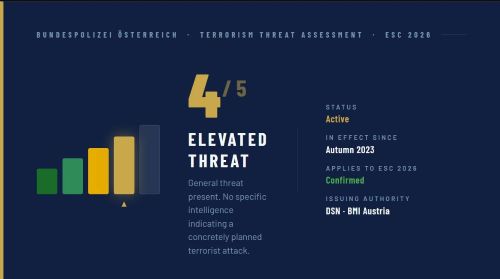
Austria currently remains at elevated terror alert Level 4 on a five-point scale. This second-highest level has been in place since autumn 2023, reflecting the heightened security situation in the Middle East and the broader threat environment across Europe.
Level 4 indicates a general threat, but without any specific intelligence pointing to a concretely planned terrorist attack. This assessment applies equally to the ESC 2026.
How should the public behave?
There are no specific known attack plans in Austria. While a generally elevated alert level applies across Europe, daily life in Austria — both public and private — can and should continue as normal. The public does not need to take any special precautions or change their behavior in any way. This applies fully and without reservation to all visitors attending the ESC 2026 in Vienna and any parallel events.
That said, any suspicious observations should be reported to the police emergency number 133 without delay.